.png)
Mindfulness for Self-Awareness: How to Understand Yourself Better

Many individuals today are essentially going through their lives on autopilot. They react to situations, make decisions, and feel emotions without fully understanding why. This lack of self-awareness can lead to great stress, miscommunications, and decisions that do not align with one's values. One of the most powerful tools that can aid in self-awareness, leading to a more emotionally balanced and fulfilling life, is mindfulness.
To utilize mindfulness as a tool for self-awareness, one must first understand that mindfulness is essentially being fully present in each moment, fully aware of one's thoughts, emotions, and physical sensations. By being more mindful, one can better understand oneself and one's place in life.
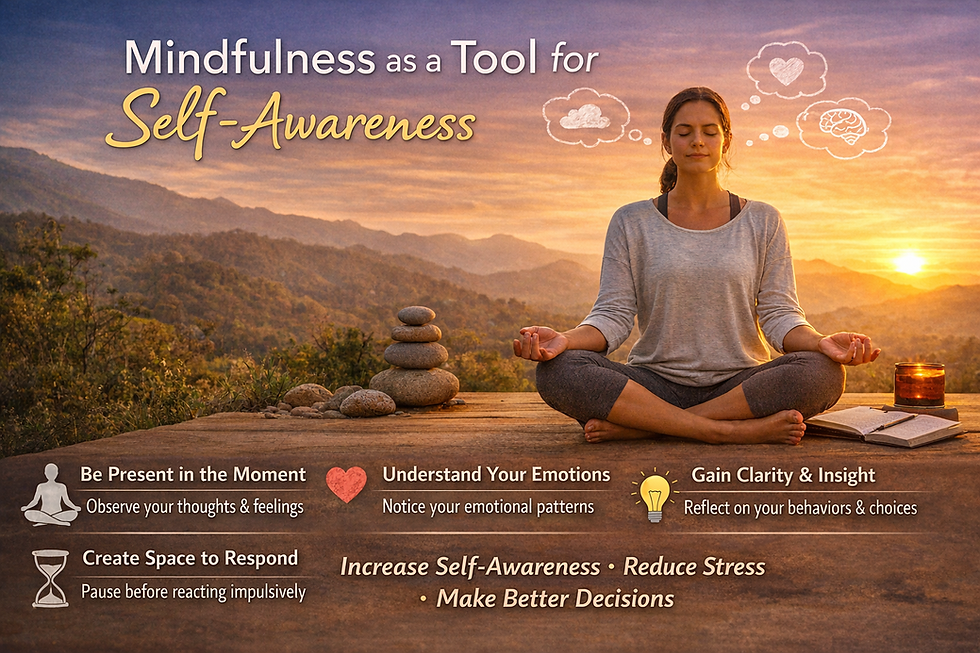
Mindfulness is a practice in which one is aware of the present moment. Instead of dwelling on the past or the future, mindfulness encourages individuals to be aware of the current moment. This involves being aware of one's thoughts, feelings, and body without labeling them as good or bad. Research has proven that mindfulness is beneficial in the current world. It has been proven that mindfulness reduces stress and improves mental clarity.
Mindfulness-based stress reduction and mindfulness-based cognitive therapy have been proven to be effective in improving one's well-being. From a scientific point of view, mindfulness has an impact on the brain. It is believed that mindfulness develops neural pathways in the brain. This enables one to be aware of their thoughts and emotions.
How Mindfulness Develops Self-Awareness
Mindfulness is a highly effective means of developing self-awareness since it enables individuals to become aware of their internal experiences without immediately acting on them. As individuals practice mindfulness, they become aware that thoughts are mere mental occurrences rather than realities. This helps them become aware of their thoughts without being controlled by them.
Another major advantage of mindfulness in self-awareness is the ability of individuals to become aware of their emotional patterns. Individuals have emotional triggers that affect their responses to certain situations. As individuals practice mindfulness, they become aware of their emotional patterns and how they affect their responses.
Mindfulness can help people become aware of behaviors that are often not noticed. For instance, someone may realize that they are using their phone because of boredom, or they may realize that they are being defensive about certain issues. By becoming aware of such behaviors, people can begin to change behaviors that do not help them anymore.
The most powerful feature of mindfulness is that it allows for space between stimulus and response. Rather than simply reacting to certain situations, people are now given the space where they can choose to do what they want. This allows for better emotional regulation and decision-making.
Practical Mindfulness Techniques to Develop Self-Awareness
There are a number of simple mindfulness techniques that can be used to develop self-awareness. Some of the most common mindfulness techniques include mindful breathing. This involves paying close attention to the natural rhythm of the breath and, at the same time, becoming aware of one's emotions and thoughts. This increases one's awareness and concentration.
Another mindfulness technique is body scan meditation. This involves paying close attention to different parts of the body, including the feelings and sensations in the body. This increases one's awareness of the body, which often responds to emotions.
Another significant practice is the mindful observation of thoughts. Instead of attempting to stop or control thoughts, individuals are advised to observe these thoughts as if passing clouds in the sky. This enables people to comprehend the fact that thoughts are transient and not necessarily a true reflection of the world.
Keeping a journal can also be a means of supporting mindfulness for self-awareness. Writing about the experiences of the day, the emotions felt, and the responses to these experiences enables individuals to reflect on patterns in thoughts and behaviors. Journaling can thus assist individuals in gaining insights for better emotional understanding and decision-making.
Benefits of Using Mindfulness for Self-Awareness
Mindfulness for self-awareness has numerous psychological and emotional benefits. Some of the most notable benefits include improved emotional control. When an individual is self-aware, he is not easily controlled by his emotions. This is because he is aware of his emotional state at all times.
Mindfulness for self-awareness also improves decision-making clarity. When an individual is self-aware, he is not influenced by his thoughts and feelings. This means he is capable of making decisions that are guided by his values and long-term objectives.
Another important advantage of mindfulness is that it helps improve relationships. When one becomes more self-aware, they are more able to understand their communication style and their emotions. It also helps improve resilience and mental well-being. One becomes able to deal with situations better by being able to face their emotions.
Common Challenges When Practicing Mindfulness
Despite the many benefits of mindfulness, there are some challenges faced by those who are new to the practice. For instance, a new practitioner of mindfulness often finds it difficult to concentrate. The mind tends to wander, and a new practitioner often gets frustrated because of the inability to concentrate completely in the present moment. However, the wandering of the mind is a natural part of the practice, and focusing on the present moment again is the practice.
A new practitioner of mindfulness also tends to get frustrated because of the inability to see the results immediately. It takes time to develop mindfulness and self-awareness. The more a person practices mindfulness, the more the practice leads to increased mindfulness.
Incorporating Mindfulness into Daily Life
Mindfulness does not have to be restricted only to meditation. It is possible to incorporate it into daily activities, such as while eating, walking, or even while at work. This will help in developing mindfulness.
It is also possible to develop daily routines that will help in incorporating mindfulness into daily activities. This will help in developing mindfulness. It is possible to incorporate reminders into daily routines or even while doing daily activities.
Conclusion
The conclusion is that mindfulness is a powerful tool for personal understanding and awareness. It helps individuals to have a better understanding of their inner workings and the world around them. It helps them to make better decisions and have better relationships with people.
Although mindfulness is not an easy practice, the results are worth the patience and practice. It helps individuals to have a better understanding of themselves, and through practice, it becomes a gateway to personal growth and well-being.
Contact Us
Contact us for a free wellbeing consultation! Our experienced psychologists and wellness experts are here to support your mental and emotional health needs. Start your journey to a healthier mind and a happier life today!


Comments